
Some stories entertain you for a moment.
Others stay with you long after you’ve finished them.
The difference? Psychological depth.
The most compelling psychological stories don’t rely on action alone, they pull readers into the minds, emotions, and conflicts of the characters in a way that feels real, intense, and impossible to ignore.
What makes a psychological story compelling?
A psychological story is compelling when it creates emotional tension, deep character complexity, and internal conflict that keeps readers mentally and emotionally engaged. These stories focus on the character’s thoughts, motivations, and struggles, making the experience immersive and difficult to put down.
When done well, psychological storytelling doesn’t just tell a story, it makes the reader feel it.
Key elements of a compelling psychological story
1. Strong internal conflict
At the core of every psychological story is conflict, but not just external conflict.
The real tension comes from within.
Characters are forced to confront:
- Their fears
- Their past
- Their identity
- Their moral limits
This is what keeps readers emotionally invested.
2. Deep, complex characters
Flat characters don’t hold attention. Real ones do.
Compelling psychological fiction explores characters who feel layered, flawed, and human.
Readers connect with characters who:
- Have contradictions
- Make difficult choices
- Struggle internally
This is what makes stories like Intimate Nightmares so immersive—they focus on emotional truth, not perfection.
3. Emotional tension (not just plot tension)
Many writers focus on “what happens next.”
Psychological stories focus on what it feels like.
Tension builds when readers are emotionally invested in the outcome.
It’s not just about events—it’s about impact.
4. Uncertainty and unpredictability
Readers stay hooked when they don’t know what’s coming next.
Psychological storytelling thrives on:
- Unreliable perspectives
- Unexpected shifts
- Moral gray areas
This creates curiosity—and curiosity keeps readers turning pages.
5. Meaningful themes
The most compelling stories say something deeper.
They explore themes like:
- Identity
- Control
- Fear
- Transformation
This is why books like Lullaby Trap and A Different Type of Skin resonate—they go beyond surface-level storytelling.
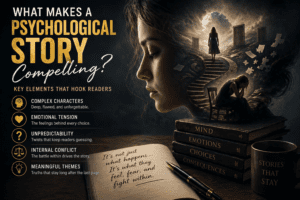
Core elements that make a psychological story engaging, including emotional tension, unpredictability, and meaningful themes.
Why psychological stories are so hard to put down
Psychological stories are hard to put down because they engage both emotion and curiosity at the same time.
Readers aren’t just following a plot—they’re trying to understand the characters, predict outcomes, and make sense of the story as it unfolds.
This creates a powerful reading experience that keeps them coming back.
Common mistakes that weaken psychological stories
1. Focusing too much on plot
Without emotional depth, even the most complex plot falls flat.
2. Underdeveloped characters
If readers don’t connect with the character, they won’t stay invested.
3. Avoiding emotional risk
The strongest stories go deeper, even when it’s uncomfortable.
What writers can learn from compelling psychological fiction
If you want your story to stand out, focus less on perfection—and more on depth.
Ask yourself:
- What is my character afraid of?
- What are they avoiding?
- What will force them to change?
Because the most compelling stories don’t just entertain.
They reveal something real.
Final Thoughts
A compelling psychological story isn’t built on action alone, it’s built on emotion, tension, and truth.
It draws readers in, challenges them, and stays with them.
And that’s what makes it unforgettable.
Read More
If you enjoyed this, read: Why People Love Dark Psychological Fiction